How Pagan is Christmas?

I wrote this blog post a couple of years ago and published it on my old blog, but it is definitely worth repostig it, I have edited it a bit added some stuff and I hope you enjoy reading or re-reading it. I will repurpose a few more over the comig weeks.
Make sure you subscribe to be kept in the loop.
Every year around this time I see an increase of claims about the pagan origins of Christmas. How the Christians stole it all from the Pagans and all the way to the claim that Santa Claus is actually the Norse God Odin.
So I thought let’s have a look at how much of that could be true. Is Christmas really pagan?
First of all, there are currently at least 14 different holidays celebrated in December. From the Christian Saint Nicholas Day on the 6th of December (I have very fond memories of this!), passing the Jewish Hanukkah on 7th to 14th of December and the Buddhist Rohatsu (Bodhi Day) and of course the Solstice around the 21st for the Pagans.
Historically there have been even more, like the Roman Saturnalia, which was quite a ruckus affair btw. They literally turned their world upside down and made beggars kings so to speak.
There is lots of celebrating going on in the winter, because let’s face it, we simply need it to see us through the dark months!

The Christmas we know now, the tree, the presents, the family feast etc., is a very modern invention. Before it became as popular as it is now, the main festival for Christians was Easter, celebrating the resurrection of Christ. Jesus’ birth wasn’t celebrated much at all and of course, you guessed it, 25th of December is highly unlikely to actually be his birthday. Funnily enough celebrating birthdays wasn’t something done by Christians and considered a Pagan tradition. Christians in the early days celebrated saints days and martyr days, which in Jesus’ case was him dying and then rising from the dead.
Christmas, when it arrived, was not popular at all with a lot of Christians and the Puritans even managed to ban it in the 17th century. Modern Christmas did not occur until Victorian times and yes Charles Dickens had a lot to do with it!
So much for ‘traditional’ Christian Christmas eh?

But how much of it actually is ancient Pagan? Surely decorating trees has nothing to do with celebrating the birth of Christ, right? No it really doesn’t, but it is also not an ancient pagan tradition as some people will have you believe. The first decorated Christmas trees occurred in Central Europe in the 16th century and are often connected to the protestant Christian reformer Martin Luther who decorated evergreen fir trees with candles and colourful paper decorations. There are also older origins assumed like “The Tree of Paradise” that appeared in medieval mystery plays depicting the Adams and Eve story, often put on in December, and the tree being decorated with the apples of knowledge, which are said to later become the baubles. And if we are talking about bringing in evergreen plants into the house to decorate, that’s been done for centuries, but it isn’t a specific pagan ritual.
But what about Santa Claus, is he actually Odin? No, really not, sorry.
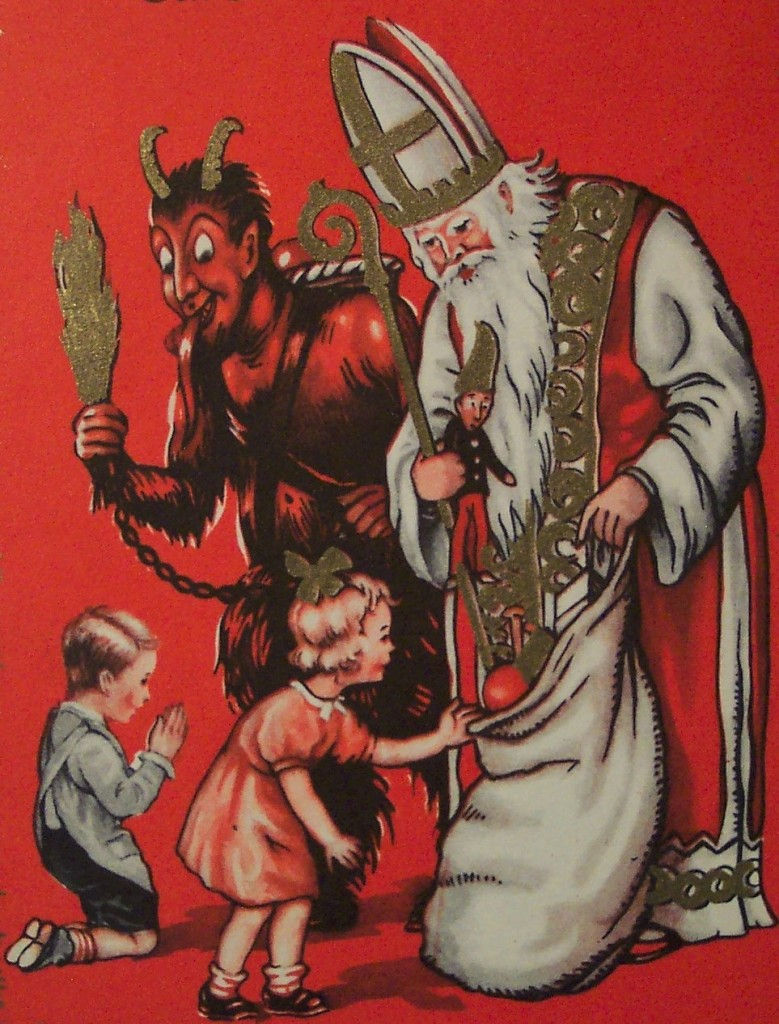
Santa Claus, has it’s origins in Saint Nicholas or Sintaklaas (Dutch), who was a bishop from Myra, located in modern day Turkey, which was Greece back then. He lived from 270 to 343 and is credited with a number of good deeds, helping people in need and miracles as good Saints are. He is still celebrated in Germany and Holland for example on the 5th/6th of December and he also has a dark counter part who is the origin of the Krampus legend. Blog post coming for that one next!
Saint Nicholas history alone could fill a very long post, but this very real person is the origin of Santa Claus. Traditionally he wore the bishops clothes, but the now popular red coat with white fur trim came from a amalgamation of a poem written in 1822 by Clement Clarke Moore called “An Account of a Visit from St. Nicholas” or better known by its first line “T'was The Night Before Christmas”, in which Santa is a holy man flying from home to home in a sledge pulled by reindeer, delivering toys and a drawing by political cartoonist Thomas Nast who drew Santa Claus from this poem in 1881 in red with a white beard, thus creating the image we all know today.

Father Christmas in the UK however has quite different origins and certainly feels more Pagan when you look at early depictions of him where he looks way more like the Holly King of Wiccan or Neopagan tradition than the modern Santa.
Unfortunately the origins of the Holly King are largely unknown and the first real mention of him as the symbol of winter isn’t until Robert Grave’s book called “The White Goddess” in 1948. So quite a bit after the Father Christmas tradition established in England with it’s origins going back to the 15th century. It is however very likely that Father Christmas evolved from something predating Christian beliefs, but there’s not much historical evidence for this.

So what am I saying? That Christmas isn’t Pagan? That can’t be right! What about Yule then? That’s Pagan, right?
Yes it is or at least that’s where it comes from. Yule is a winter festival that was originally celebrated by the Germanic people to celebrate the God Odin (there he is!), the Wild Hunt (this will feature in another blog post coming soon) and a day called Mōdranith, which translates as “Mother’s Night” a celebration by Anglo-Saxon Pagans. It has one hell of a rich story around it and I urge you to look into it, but for the sake of this blog post here I shall move on.
All of it was incorporated into Christmas during the Christianisation of the Germanic peoples which slowly happened between 700 and 1100 AD.
The original Yule wasn’t necessarily celebrated around the time we now celebrate Christmas, there is a Nordic text that describes it to happen as a three day feast starting on ‘Midwinter Night’, which was however different to the date of Solstice and more likely to have been a month later in January. We must also remember that the Gregorian calendar we observe today wasn’t in use until 1582, so a lot of dates have changed.

Obviously there are many Christmas traditions still linked to Yule like the Yule Log, Yule singing or the Yule goat.
Okay, let’s have one more go at this, we surely can find something completely Pagan the Christians “stole” for Christmas, right?
So my last offering to this list is the Winter Solstice, of course. That can’t be moved or changed as it’s an astronomical event that happens at the same time as long as the Earth goes around the Sun and obviously it is no coincidence that Christmas happens around the same time (In the northern hemisphere at least!) I mean it’s no stretch to the imagination that a celebration of the Winter Solstice as the “Rebirth of the Sun” turns into the “Birth of God’s Son”, is it? Emperor Constantine decided to celebrate the birth of Jesus on the 25th of December likely to deliberately compete with the Pagan celebrations around the returning Sun.
There it is! They stole the date!

Okay, now lets all breathe here for a minute. All religions and belief systems “borrowed” and incorporated each others festivals and traditions. That’s been going on for as long as humans have created beliefs. Often it was done to make it easier for people to convert. I am not saying that those things are right, but they were done when one religion took over from another.
A lot of things we do at Christmas in modern times might be traced back to much older traditions and maybe have nothing to do with Christianity of course and I think that’s okay.
Don’t get me wrong, Christians and Pagans have hardly seen eye to eye historically speaking and yes, Christianity or the Abrahamic religions have a lot to answer for, but when I see Pagans scream that the Christians stole Christmas or the hardcore Christians that demand to put “The Christ back into Christmas” I can’t help but wonder why we can’t share it.
Spirituality and faith if you like should be an ongoing ever evolving thing, it only ever starts being problematic when it becomes dogmatic!
Dogma is the end of all joy, all spiritual evolution and any fulfilling faith. If you insist on your way or nothing, it doesn’t matter wether you come from a Christian background or a Pagan one, I for one will stop listening to you. It simply destroys the spirit of any celebration and whenever somebody claims they know the “right” way of celebrating anything, they are wrong.
So are we any wiser now?
Is Christmas Pagan or isn’t it?
Possibly…who cares? There are so, so many festivals, rituals, traditions that happen at this time of year we can’t actual tell anymore what is what. I don’t think Christmas, as most people these days celebrate it, is even Christian anymore, it has almost become a secular holiday that everyone can celebrate regardless of religion, if they so wish and isn’t that amazing?
In the middle of the dark time of the year we have created a festival of light, giving and sharing, of indulging, feasting and being merry.
If you can largely resist the ever growing commercial crap, which I have always managed so far, Christmas, Yule, Hanukkah, Saint Nicholas Day, Winter Solstice and even Saturnalia all have something important in common. Hope and happiness during the dark times and that I will celebrate all day long!
Blessings to you all

P.S. Don't forget to leave a comment further down


Comments